How to Use a Food Thermometer Properly
Learn where to place a food thermometer, how to check more than one spot and why cooking temperatures and rest times matter.
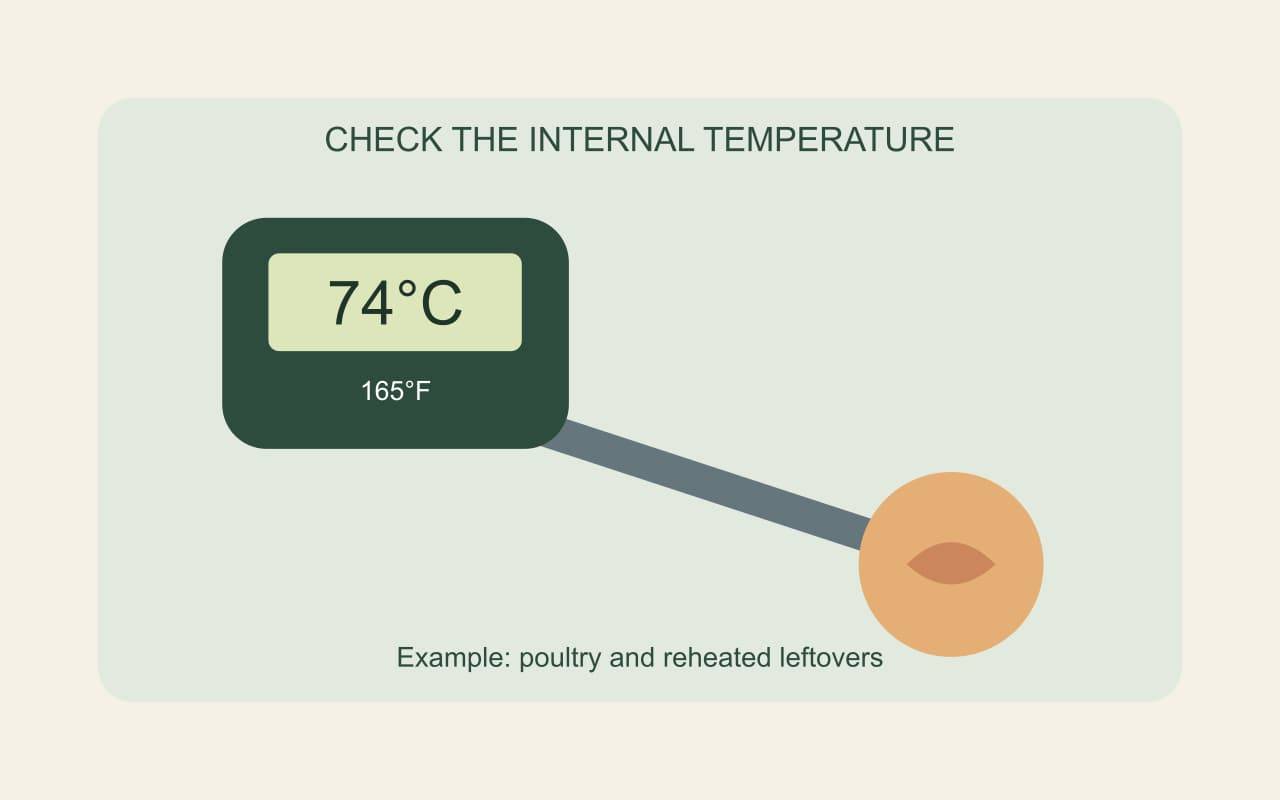
A food thermometer answers a question that color and cooking time cannot reliably settle: what temperature has the food reached inside? The important skill is putting the sensing area in a useful place and comparing the reading with the right guidance for that food. One quick measurement against a hot pan does not tell you whether the center of dinner has reached a safe temperature.
Understand the thermometer you own
Read the instructions before relying on a new thermometer. Different designs measure through different portions of the probe, need different response times and may have different temperature limits. An instant-read thermometer is generally used to check food during or after cooking, while a leave-in model may be designed to remain in place. Do not assume that every probe can be left in an oven or used in the same way.
Check how the display works and whether the device is set to Celsius or Fahrenheit. A correct-looking number in the wrong unit can lead to a serious misunderstanding. Keep the instructions or model information somewhere accessible so you can check cleaning, battery and calibration requirements later.
Measure the thickest relevant area
For many foods, the useful location is the thickest part, away from bone and the cooking surface. Contact with a hot tray, a pocket of fat or a bone can give a misleading impression of the surrounding food. Insert the probe so that its sensing area is within the food rather than partly exposed to hot air. Follow the device instructions when checking thin foods, where a sideways insertion may be needed.
A large or uneven piece can have several temperatures. Check more than one location instead of choosing the most reassuring reading. With a tray of separate pieces, consider their different sizes and positions. The smallest piece is not a dependable stand-in for the largest one beside it.
Use guidance for the specific food
FoodSafety.gov lists different minimum internal temperatures and, for some meats, rest times. For example, its chart specifies 165°F or 74°C for poultry and leftovers. Whole cuts of beef, pork, veal and lamb have a different instruction: 145°F or 63°C followed by a three-minute rest. Ground meats have their own guidance, so the whole-cut instruction should not be copied across to a burger.
Use the current chart for the exact food you are preparing, including stuffing, egg dishes or casseroles where relevant. The brief examples here do not replace the full table. A recipe's time estimate helps with planning, but the thermometer checks what happened in your particular oven, pan and piece of food.
Give the reading time to settle
Hold the probe steadily for the response time described by the manufacturer. If the reading changes rapidly, wait for the appropriate stable result rather than taking the first number that appears. Avoid pulling the probe partway out while watching the display, because you may then be measuring a different area. Keep your hand clear of hot surfaces and use suitable protection around the oven or grill.
If the food has not reached the required temperature, continue cooking and check again. Clean the probe as appropriate between checks, particularly if it has contacted undercooked food. Do not transfer contamination from a probe, board or pair of tongs to food that is ready to eat.
Respect rest times and the whole instruction
A rest time is part of the safety guidance for foods that require it. It is not simply a suggestion to leave the plate waiting while you finish a sauce. Once the specified temperature is reached, follow the rest instruction before carving or serving. Do not invent an alternative combination of a lower temperature and a longer rest unless you are following validated guidance for that exact method.
Likewise, a microwave's standing time can be part of the cooking instructions. Stir or rotate when directed and check the required areas. A hot edge does not prove that the center of a reheated dish has warmed evenly. Follow package instructions for commercially prepared foods as well as the relevant temperature guidance.
Check accuracy using the manufacturer's method
Some thermometers can be checked or calibrated using a recommended ice-water or boiling-water method, but the procedure and adjustment differ between devices. Read the instructions rather than forcing a digital model through a process intended for another design. Boiling-water checks also need attention to local conditions, including elevation. If a device gives implausible results, resolve that before using it for a safety decision.
Store the thermometer so the probe is protected and easy to find. A useful kitchen tool should be available before the food is already waiting to be served. Replacing a weak battery and cleaning the device according to its instructions are small jobs that make the next measurement more dependable.
Use the thermometer as part of safe handling
Reaching a cooking temperature does not make food immune to contamination or unsafe storage afterward. Use clean utensils, keep raw and ready-to-eat ingredients apart, and refrigerate perishable leftovers promptly. If you are preparing components in advance, our grain-bowl meal-prep guide includes a practical cooling and storage plan.
The thermometer's value is precision in the right place. Match the probe to the food, take a patient reading, use the correct temperature and rest guidance, and keep the surrounding handling just as careful.